The First Enterprise Agent Deployment Should Be Boring
Choose a frequent, bounded, reviewable workflow, integrate only the systems it needs, and build a harness for that deployment.
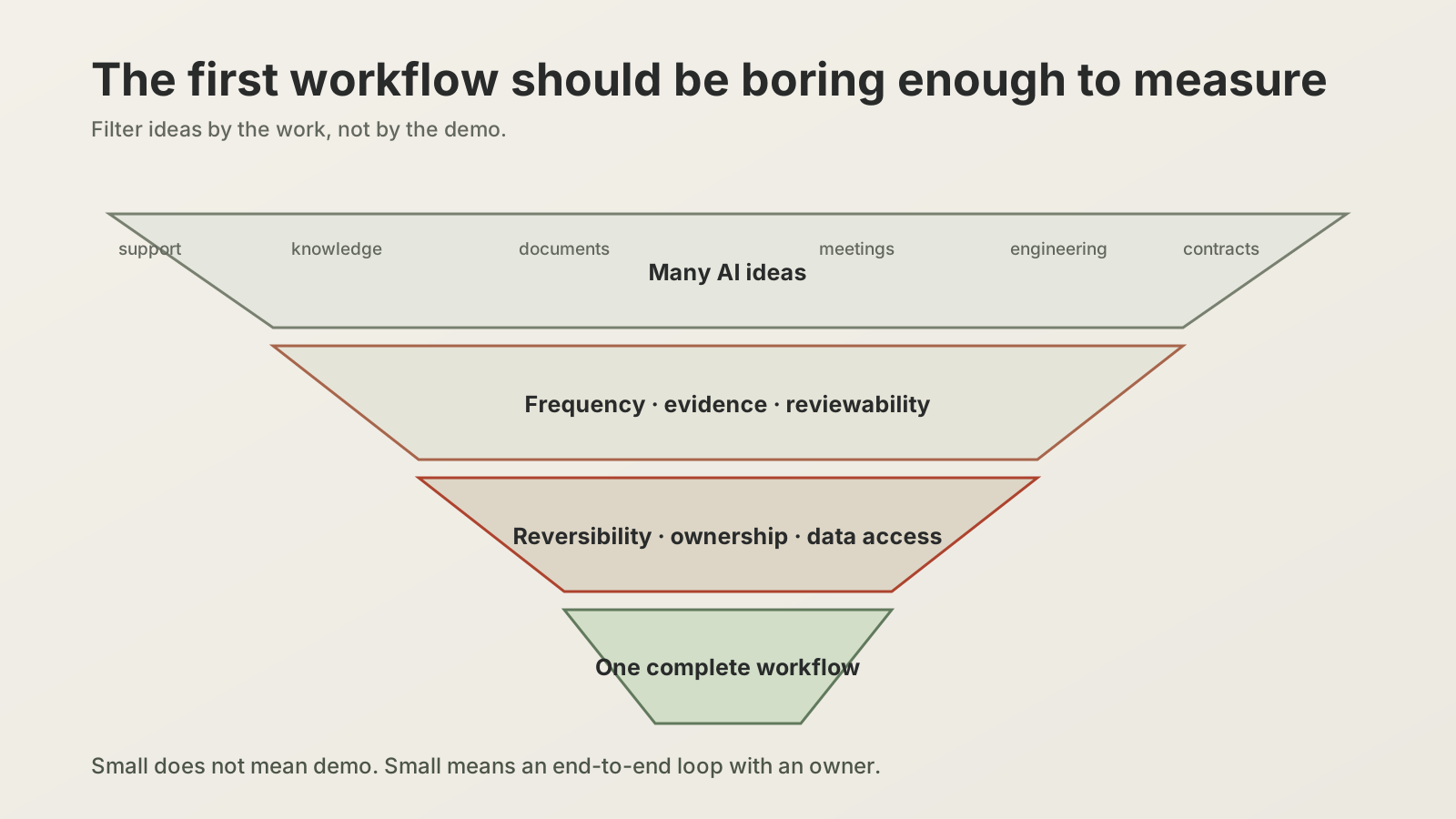
The first enterprise agent should not make the company’s most strategic decision.
It should prepare the release notes.
Or enrich a support ticket. Or extract a document into a review queue. Or assemble the evidence for a dependency upgrade.
The first workflow should be frequent, bounded, reviewable, and owned. That may sound unambitious. It is how a team learns what production AI actually requires without discovering every failure mode inside a critical process.
Score workflows before vendors
Most enterprise AI backlogs begin as a list of ideas: automate support, build a knowledge agent, summarize every meeting, review contracts, modernize engineering.
Turn that list into a decision table.
Score each workflow from 1 to 5 on:
| Dimension | The useful question |
|---|---|
| Frequency | Does this happen often enough to create a learning loop? |
| Current effort | Is meaningful time or delay attached to it? |
| Input clarity | Can we identify the evidence a skilled person uses? |
| Output clarity | Can a reviewer recognize a good result? |
| Reversibility | Can a bad result be caught or undone? |
| Ownership | Is one business owner accountable for the workflow? |
| Data access | Can the team legally and technically access the inputs? |
| Feedback | Will corrections become usable product evidence? |
| Integration cost | Can the first loop close without a year of platform work? |
Do not total the scores blindly. A lack of ownership or data access can rule out a workflow that looks attractive everywhere else.
Pick a decision packet, not a digital employee
A strong first deployment often does four things:
- gathers the relevant evidence
- performs bounded analysis
- drafts a recommendation or artifact
- routes uncertainty to a person
That is a decision packet.
For a dependency upgrade, the packet may contain affected packages, breaking changes, a proposed patch, test results, and unresolved risks. For a brokerage document, it may contain extracted fields, source-page references, confidence, and exceptions. For support, it may contain account history, the likely issue, policy checks, and a draft response.
The agent has compressed search and preparation. A person still owns the consequential decision.
This is a better first target than “end-to-end autonomy” because the value and failure are both visible.
Build one complete loop
The first release needs an end-to-end path:
source event
  → approved context
  → bounded agent work
  → deterministic checks
  → review and correction
  → recorded outcome
Connect only the systems required to close that loop.
If release-note preparation needs GitHub, the repository, and a publishing draft, do not also integrate Slack, Jira, the data warehouse, and every internal wiki because they may become useful later. Each connection adds identity, permissions, failure handling, and support work.
The goal is not a small demo. It is a small complete system.
Build a harness for the deployment
Enterprise teams should share common primitives: model access, identity, approved tools, telemetry, evaluation infrastructure, and policy. The workflow still needs its own harness.
That harness defines:
- source systems and freshness rules
- context selection and provenance
- allowed actions and approval boundaries
- workflow state and recovery
- acceptance checks
- exception handling
- review experience
- accountable owners
A claims workflow and a coding workflow can share an inference gateway. They should not share the same evidence rules or permission envelope.
This is why large “agent platform first” programs often struggle. They standardize the visible infrastructure before the organization understands the work-specific details that produce trust.
Design the exception queue before launch
The first deployment will encounter unreadable documents, conflicting records, failed tools, unsupported requests, and cases outside the evaluated distribution.
The exception queue should show:
- what the system was asked to do
- which evidence it found
- what it attempted
- why it could not finish
- what decision or data is needed
- who owns the next action
Let reviewers correct structured fields and record the reason. Those corrections can become eval cases, retrieval fixes, tool improvements, or workflow rules.
An exception is not a failed product. An exception nobody can understand is.
Pilot with a baseline and a stop rule
Before the pilot, measure the current workflow: volume, elapsed time, hands-on time, rework, error categories, and review burden.
Then run with a small, representative group. Track accepted outcomes rather than generated output. Interview both the people using the system and the people reviewing what it produces.
Define conditions that pause expansion:
- high-severity error reaches a downstream user
- review time exceeds the time saved
- required data access is broader than approved
- exception volume overwhelms the owner
- the team cannot reproduce or explain a failure
A pilot is valuable partly because it can tell you not to scale yet.
Productize what repeats
After several real runs, ask what should become reusable:
- a connector
- a permission profile
- a document schema
- a review component
- an eval fixture
- a recovery procedure
- a skill or workflow template
This is the field-learning loop behind forward-deployed engineering. Customer-specific work becomes leverage only when the learning changes the product.
DORA’s 2025 research describes AI as an amplifier of an organization’s existing strengths and weaknesses. That is the right expectation for a first deployment. A clear, owned workflow becomes faster. A confused workflow becomes a faster way to produce confusion.
Choose something boring enough to measure and important enough that people ask for the second one.